
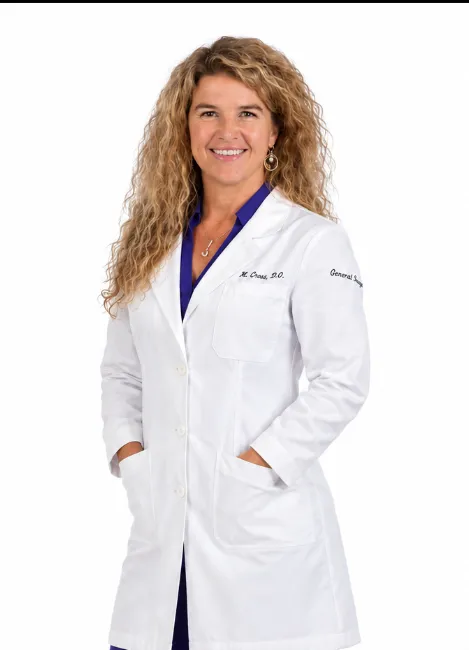
Your surgeon
Dr. Wanda Good, D.O.
Dr. Wanda Good is a general surgeon with additional fellowship training in Advanced Robotic, Bariatric and Anti-Reflux Surgery, as well as endoscopic evaluation and bariatric procedures. She is the founder and CEO of Ascend Surgical Alliance.
She has built her practice on general surgery foundations with special attention on two conditions that are often treated at the surface and rarely investigated or addressed at the source: metabolic disease and acid reflux.
After several years living, working, and enjoying the outdoor life of Colorado, she earned a Bachelor of Arts in Kinesiology at the University of Colorado Boulder. That followed dual Associate of Arts and Sciences degrees at Colorado Mountain College in Steamboat Springs, where she graduated valedictorian with a 4.0. She completed her medical education at Kansas City University of Medicine and Biosciences, and returned to Denver for her clinical rotations in the third and fourth years of medical school.
As a Doctor of Osteopathic Medicine, that philosophy of education informs her approach to patient care and the collaborative relationship she builds with her patients and their families. Dr. Good believes in talking with them, explaining their pathology, answering questions, and building their trust and their knowledge. That diminishes anxiety around office visits, emergencies, and surgery.
After studying at La Universidad de Sevilla in Spain, she speaks advanced Spanish, and believes the same goals are achieved for her Spanish speaking patients and their families by speaking with them in their own language.
Training
Dr. Wanda Good, D.O. completed a fellowship in minimally invasive, advanced laparoscopic, robotic, bariatric and anti-reflux surgery at the University of Arizona in Tucson, and residency in general surgery at University of Medicine and Dentistry of New Jersey, Stratford, NJ.
Five of seven training years were general surgical training, which is why hernia, gallbladder, and appendix care sit comfortably alongside the metabolic and foregut work.
She currently practices in Denver.
Approach to care
Evaluate and treat the person. Address and improve the symptoms. That is not a slogan, it is a sequence. Testing comes before treatment, the mechanism gets explained in plain language, and the plan follows from what the testing actually shows.
Metabolic disease is physiology, not willpower. Reflux is a condition, not a character flaw or a diet failure. Patients are not told what they did wrong. They are told what is happening and what can be done about it.
Nothing is recommended by default. An operation is one option among several, and the nonsurgical paths are put on the table with the same seriousness.
Clinical philosophy
The focus is metabolic health, not just the number on the scale. Blood sugar, blood pressure, sleep, joint pain, and reflux burden are the things that change how a person lives, and those are what get tracked.
Reflux gets equal standing with metabolic care in this practice. The two influence each other, and evaluating one without considering the other misses a large part of the picture.
Care is collaborative. She works with the referring clinician throughout and returns the patient to them with clear documentation of what was done and what to watch for.
What a consultation is like
Expect a long conversation. History first, then examination, then a review of any testing you bring. After that comes the discussion: the likely cause, what further testing would clarify, and every reasonable option including waiting.
Most first visits do not end in a decision. They end with a plan for getting the information a decision needs. Questions are welcome, and a written list is encouraged.
Before you leave, three things should be clear: what happens next, who is doing it, and when you will hear something.
Leadership and teaching
She has performed nearly 2,000 robotic procedures. Since 2014 she has been a da Vinci Si, Xi and DV5 robotic surgery proctor for Intuitive Surgical, which means she trains other surgeons on the robotic platform.
She served as Chair of the Department of Surgery at Lourdes Health in Pasco, Washington from 2021 to 2023, as Medical Director of the Lourdes Center for Metabolic and Bariatric Surgery from 2016 to 2023, and as Director of Robotic Surgery at Lourdes Health from 2019 to 2023.
Earlier, at Yakima Regional Medical Center from 2014 to 2016, she was Medical Director of the Metabolic and Bariatric Surgery Program, Director of Trauma Surgery, Vice Chair of the Department of Surgery, and Chair of the Professional Peer Review Committee.
She served on the Surgical Executive Committee and chaired the Robotic Surgery Committee at a Denver area hospital through February 2026.
She taught as an Adjunct Clinical Professor and general surgery preceptor at Pacific Northwest University School of Osteopathic Medicine from 2014 to 2023, and as a general surgery preceptor at Central Washington Family Medicine Residency from 2014 to 2016.
Professional memberships and continuing education
She is a member of SAGES, ASMBS, and the American Foregut Society, and attends and speaks at those meetings. She was a named speaker at the American Foregut Society annual meeting in 2025. This field changes quickly. Staying current is part of the work, not an extra.
Confirmed licensure and memberships are listed on the credentials page.
Talk it through
A consultation is a conversation about what is happening and what the options are. Nothing is decided for you.